Rännakud algavad täistunnil / Viimane VR-tuur 1 h enne sulgemist
Hotell Palace
Republic of Estonia and Five Fates
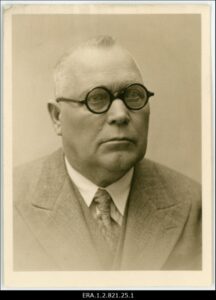
Estonian influential and wealthy businessman Johannes Mürk (1874-1946) Death in Exile
Johannes Mürk. 1938. Estonian National Archives, ERA.1.2.821.25.1
Johannes Mürk was an Estonian businessman, politician, and member of the Riigikogu (Estonian parliament).
He participated in the Estonian War of Independence (1918-1920).
The Estonian War of Independence played a crucial role in the country’s independence, commemorated by the monument in Freedom Square known as the Victory Column of the War of Independence. The monument is crowned with the Cross of Liberty, which was Estonia’s highest award.
Johannes Mürk was the owner of the Palace Hotel and chairman of the board of the Estonian Insurance Society (EEKSI House). It was thanks to his efforts that the Palace Hotel was built. His motto was: “Only the best of the best is good enough for a hotel that must mark a new era in the hotel industry.”
Johannes Mürk died in exile in Sweden, a fate shared by many Estonians. He did not witness the independence of Estonia nor the atrocities of the Soviet era.
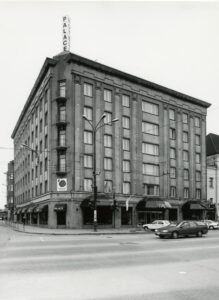
Hotel Palace
Hotel Palace. Architect Elmar Lohk. Estonian Museum of Architecture. EAM Fk 1642.
The architecture of Hotel Palace stands as a testament to the pre-war Republic of Estonia’s finest architectural achievements. Among them, Palace was the first upscale hotel in Tallinn. Completed in 1936, it was designed by architect Elmar Lohk.
The facade of Hotel Palace embodies the Art Deco style, characterized by zigzags, straight lines, and simplicity. The striking advertising tower still present on the roof adds a stylish urban design element to modern-day Tallinn. Newspapers referred to Hotel Palace as a palace indeed. The hotel had 50 guest rooms, each more luxurious than the last. On the sixth floor, J. Mürk had a 6-room luxurious apartment. Catering to the most demanding and affluent clientele, each floor had a larger hotel suite consisting of an entrance hall, two rooms (with access to a balcony), and a bathroom.
During the Soviet era, Hotel Palace shared a fate similar to many other businesses in Tallinn. Nationalized in 1940, Johannes Mürk fled to Sweden with his wife and children. Despite this, Hotel Palace maintained its special status even during the Soviet era, hosting foreigners and important guests. The hotel continues to operate successfully to this day.
Question
Why do you think the Palace Hotel is significant and belongs on the list of cultural heritage sites?
Hint
Look for the next QR code around the surroundings of the former EKA building. The abbreviation “EKA,” which nowadays reminds us of the Estonian Academy of Arts, actually originally stood for the Estonian Insurance Company (Eesti Kinnituse Aktsiaselts). Look for a building with a diamond pattern on the facade.
Location of the next QR code
Cookie Consent
We use cookies to improve your experience on our site. By using our site, you consent to cookies.
Used to monitor number of Google Analytics server requests
10 minutes
__utmb
Used to distinguish new sessions and visits. This cookie is set when the GA.js javascript library is loaded and there is no existing __utmb cookie. The cookie is updated every time data is sent to the Google Analytics server.
30 minutes after last activity
__utmc
Used only with old Urchin versions of Google Analytics and not with GA.js. Was used to distinguish between new sessions and visits at the end of a session.
End of session (browser)
__utmz
Contains information about the traffic source or campaign that directed user to the website. The cookie is set when the GA.js javascript is loaded and updated when data is sent to the Google Anaytics server
6 months after last activity
__utmv
Contains custom information set by the web developer via the _setCustomVar method in Google Analytics. This cookie is updated every time new data is sent to the Google Analytics server.
2 years after last activity
__utmx
Used to determine whether a user is included in an A / B or Multivariate test.
18 months
_ga
ID used to identify users
2 years
_gali
Used by Google Analytics to determine which links on a page are being clicked
30 seconds
_ga_
ID used to identify users
2 years
_gid
ID used to identify users for 24 hours after last activity
24 hours
_gat
Used to monitor number of Google Analytics server requests when using Google Tag Manager
1 minute
Marketing cookies are used to follow visitors to websites. The intention is to show ads that are relevant and engaging to the individual user.