VR tours start on the hour / Last tour 1 hr before closing
Vabaduse väljak
Republic of Estonia and Five Fates
Estonia’s first president Konstantin Päts (1874-1956) Imprisonment and death in exile
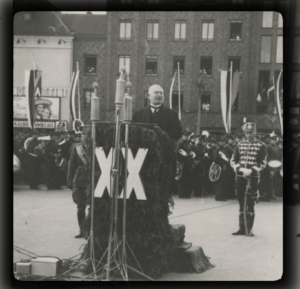
Victory Day parade at Freedom Square – Konstantin Päts is at the podium. 1938. Estonian History Museum, AM F 32907:1
Konstantin Päts was an Estonian statesman, lawyer, journalist, and one of the most influential politicians in Estonia from 1918 to 1940, serving as Estonia’s first president from 1938 to 1940.
He was one of the founders of independent democratic Estonia but also a restricter of its democracy during the so-called Silent Era.
The Silent Era refers to the period in Estonian history from 1934 to 1940. The regime of that time is characterized as an authoritarian regime, with extensive limitations on the ability of individuals to express their opinions and participate in political life.
Päts was a State Elder for four terms, as well as a Prime Minister in the duties of a state elder and a state keeper, and the first President of the Republic of Estonia after the 1938 elections.
After Estonia was occupied by the Soviet Union in 1940, representatives of the Stalinist regime forced Päts to resign from the presidency and took him and his family to Russia.
Päts died in 1956 while in prison near Tver (then Kalinin) in the former Soviet Union, without seeing the restoration of Estonia’s independence.
Listen to Konstantin Päts’ speech about Estonia:
Audio recording: State Broadcasting’s recording from 1939. Copy from the matrix 2CS1439 preserved in the central archive of EMI in Hayes, England.
Freedom Square
Freedom Square is the main square in the city center of Tallinn, Estonia, surrounded by some of the finest examples of pre-war Estonian Republic architecture, which you will get to know today. Throughout history, it has been known by various names such as Hay Market, Wood and Hay Market, Peter’s Square, Freedom Square, and Victory Square. In 1910, it was renamed Peter’s Square and a monument to the Russian ruler Peter I was unveiled there. The monument to the Russian emperor was removed from the square by the decision of the government of the Republic of Estonia in 1922. In 1923, Peter’s Square was renamed Freedom Place and later became known as Freedom Square.
Freedom Square hosts events commemorating the independence of the Republic of Estonia, such as the Defense Forces Parade on February 24th every year. The square also hosts larger demonstrations or concerts, for example, on December 31st, the last day of the year.
Question
If you listened to President Päts’ speech, can you recall what he liked to compare Estonians and Estonianhood to?
Hint
Look for the next QR code around a hotel named as a noun – a large house that is the official home of a king, queen, or other person of high social rank. Please follow the traffic rules and stay attentive!
Location of the next QR code
Cookie Consent
We use cookies to improve your experience on our site. By using our site, you consent to cookies.
Used to monitor number of Google Analytics server requests
10 minutes
__utmb
Used to distinguish new sessions and visits. This cookie is set when the GA.js javascript library is loaded and there is no existing __utmb cookie. The cookie is updated every time data is sent to the Google Analytics server.
30 minutes after last activity
__utmc
Used only with old Urchin versions of Google Analytics and not with GA.js. Was used to distinguish between new sessions and visits at the end of a session.
End of session (browser)
__utmz
Contains information about the traffic source or campaign that directed user to the website. The cookie is set when the GA.js javascript is loaded and updated when data is sent to the Google Anaytics server
6 months after last activity
__utmv
Contains custom information set by the web developer via the _setCustomVar method in Google Analytics. This cookie is updated every time new data is sent to the Google Analytics server.
2 years after last activity
__utmx
Used to determine whether a user is included in an A / B or Multivariate test.
18 months
_ga
ID used to identify users
2 years
_gali
Used by Google Analytics to determine which links on a page are being clicked
30 seconds
_ga_
ID used to identify users
2 years
_gid
ID used to identify users for 24 hours after last activity
24 hours
_gat
Used to monitor number of Google Analytics server requests when using Google Tag Manager
1 minute
Marketing cookies are used to follow visitors to websites. The intention is to show ads that are relevant and engaging to the individual user.